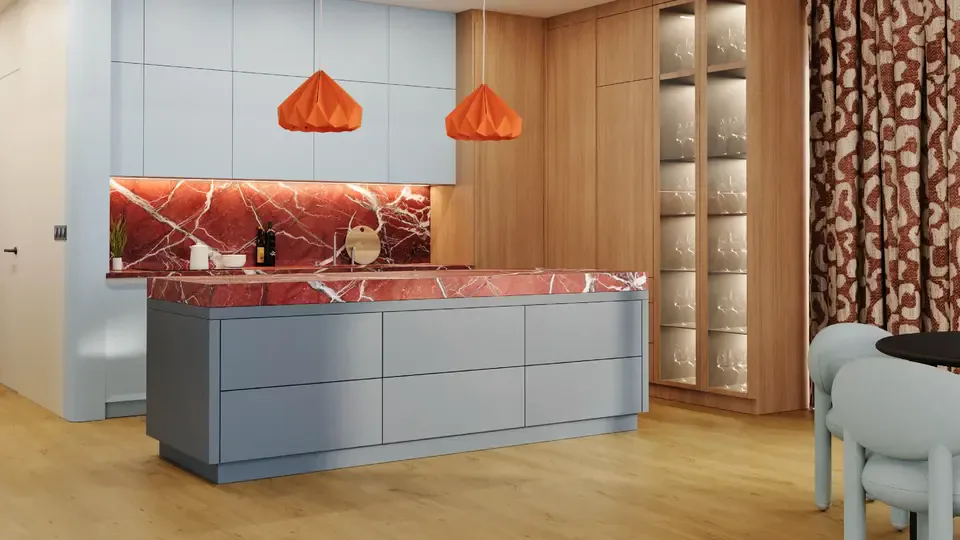
Heavy kitchen furniture should not be placed directly on vinyl panels installed using the floating method. The VinCore instructions recommend cutting holes in the floor and installing such furniture directly on the floor, maintaining expansion gaps. Objects weighing more than 300 kg (with equal load) should not be placed on the floor. Lighter free-standing furniture can be placed on panels, protecting them with felt pads. Below we explain where these rules come from and how to plan a kitchen with vinyl flooring.
The most important rules at a glance
- Heavy construction - mounted on the ground, in holes cut in the floor, with expansion joints maintained.
- Load limit - do not place objects weighing more than 300 kg directly on the floor.
- Expansion joints - 6 mm around kitchen furniture, islands, sliding wardrobes, pipes and columns.
- Sealing - in the kitchen, MS or PU sealing compound under the finishing profiles.
- Free-standing furniture - felt pads for legs; move furniture, not move it.
- Warranty - excludes damage caused by placing heavy objects directly on the floor.
Why shouldn't heavy furniture be placed on a floating floor?
VinCore vinyl panels with a click system are designed for floating installation. This means that they are not glued to the surface, but connected with each other with locks and lie freely. Such a floor requires little freedom of movement, so an expansion gap is left near walls and fixed elements.
Heavy, fixed structures placed on panels press the floor to the ground and limit its freedom in this place. At the same time, long-term, concentrated load acts on the underlay and brackets. For this reason, the manufacturer recommends that heavy furniture rests on the ground and not on the floor.
VINCORE · KITCHEN SYSTEM
Kitchen furniture and heavy furniture on a vinyl floor
| Situation | Recommendation according to VinCore instructions |
|---|---|
| Heavy kitchen or furniture furniture | Cut holes in the floor and mount directly on the floor |
| Items over 300 kg | Do not place directly on vinyl flooring |
| Island, sliding wardrobes, columns, pipes | Expansion joint around each permanent element |
| Freestanding furniture | Felt leg pads; don't move it, just move it |
| Sink and dishwasher area | Clean up spills immediately; Seal the profiles with MS or PU mass |
| Guarantee | Disabled: Heavy furniture placed directly on the floor and moved |
Source: VinCore assembly manual.
What does the VinCore manual say?
VinCore flooring installation instructions contain two clear rules on this matter:
- it is not recommended to place or mount heavy objects weighing over 300 kg (with equal load) directly on the vinyl floor,
- in the case of heavy furniture or kitchen structures, it is recommended to cut holes in the floor and install them directly on the surface, maintaining expansion joints.
Additionally, the instructions require expansion joints around the perimeter of the room and around permanent objects, directly mentioning furniture in the kitchen, kitchen islands and sliding wardrobes. In humid rooms, including the kitchen, MS or PU polymer sealing compound is used under the finishing profile.
How to plan a kitchen with vinyl flooring?
It is easiest to take into account installation rules at the design stage, before floor installation begins. The sequence of work may look like this:
- Kitchen design - determining which building elements will be heavy and permanently attached, for example rows of lower cabinets with stone countertops or an island.
- Preparation of the substrate - leveling with a tolerance of 2 mm per 1 m and 1 mm per 20 cm and drying to the required humidity (below 2.5% for cement substrate, below 0.5% for anhydrite substrate).
- Acclimatization of the panels - at least 24 hours indoors, at a temperature of 18-27°C.
- Floor installation - with holes cut out in places of heavy construction and a 6 mm gap around them.
- Assembly of the structure - heavy furniture rests on the ground, not on the panels.
- Finishing - profiles and strips masking gaps, with MS or PU sealing compound in the wet zone.
The final assessment of the substrate and installation method rests with the installer. The manual recommends using certified installers and, in case of doubt, contact the manufacturer at help@epuflooring.pl.
Kitchen island on vinyl panels
The kitchen island is a permanent element of the interior, often with a heavy countertop and appliances. The instructions list kitchen islands among the objects around which expansion joints should be made. If the island is heavy, the principle of mounting the heavy structure on the ground, in a hole cut in the floor, also applies. A 6 mm gap is left around the island, which is covered with a plinth or profile so that the floor can work freely.
Free-standing furniture and kitchen appliances
Lighter furniture that is not permanently attached, such as a table, chairs or small shelves, can be placed on a vinyl floor. The manual then recommends several protection rules:
- felt pads for the legs of tables, chairs and other furniture,
- moving furniture instead of dragging it across the floor,
- cleaning mats at the entrance that reduce the amount of sand on the floor.
In the case of heavier free-standing devices, it is worth checking their weight and contents and referring it to the 300 kg limit in the instructions. The floor's resistance to pressure is confirmed by test results: the residual dent according to EN 434 does not exceed 0.2 mm, and in the W-type wheel resistance test according to EN 425, the floor passed 25,000 cycles without noticeable changes.
Sink and dishwasher area
The kitchen is a room where the floor is often in contact with water. The hard core is fully waterproof, but water should not penetrate under the floor. This is why:
- spilled liquids should be collected immediately, in accordance with care recommendations,
- MS or PU sealing compound is used under the finishing profiles in the kitchen,
- it is worth regularly checking the tightness of the sink and dishwasher connections.
VinCore warranty cards cover common water and food spills, provided they are cleaned up immediately. However, damage caused by flooding and failures of the water and sewage installations are not covered.
Why is vinyl flooring good for the kitchen?
The construction rules do not change the fact that hard-core vinyl planks are a practical choice for the kitchen. The core made of a composite of stone and polymers is fully waterproof, and the stain resistance is confirmed by class 5 for substance groups 1 and 2 and class 4 for group 3 in the test according to EN 438. R10 anti-slip properties according to DIN 51130 increases safety when the floor is wet. The integrated IXPE foam backing reduces impact sounds by 19 dB, which is important in a kitchen open to the living room, where the sounds of footsteps and sliding chairs are easily carried.
In a kitchen with heavy traffic, it is worth considering WOOD+ or HERRINGBONE+ collections with a 0.55 mm wear layer and usability class 23/33.
You can read more about the selection and installation of flooring in rooms exposed to moisture in the article about vinyl flooring for the kitchen and bathroom.
Kitchen open to the living room - expansion joints in a large space
One floor in the kitchen and living room organizes the interior, but for larger surfaces it requires planning expansion joints. Areas larger than 200 m² and rooms longer or wider than 20 m should be divided with 8 mm wide gaps. The manual also recommends gaps in thresholds when adjacent rooms differ in temperature, underfloor heating, shape or dimensions, or when one of them contains heavy elements, for example kitchen furniture.
Kitchen renovation on existing tiles
During renovation, VinCore panels can be placed on even, stable ceramic tiles, provided that the joints are shallower than 2 mm and narrower than 4 mm. The manufacturer recommends smoothing the tiles with a cement leveling mortar. Heavy buildings should still rest on a stable surface, in holes cut in the new floor.
Underfloor heating in the kitchen
If the kitchen has underfloor heating(/__inspiration/vinyl-underfloor-heating), VinCore panels can be laid on it, with the floor surface temperature up to 27°C and the temperature gradually increased. The manual recommends an expansion gap in the threshold when underfloor heating only works in one of the adjacent rooms.
Construction and warranty
Furniture policies have a direct impact on your warranty. VinCore warranty cards exclude from protection, among others:
- damage resulting from placing heavy objects, such as furniture or kitchen furniture, directly on the floor,
- damage caused when moving furniture,
- damage resulting from improper securing of chair wheels, table legs and furniture bottoms,
- damage resulting from installation inconsistent with the manufacturer's technical documentation.
The manual also reminds that failure to follow its recommendations may result in invalidation of the warranty.
Sliding wardrobes and installations in other rooms
The same rules apply not only to the kitchen. The manual lists sliding wardrobes among the objects around which expansion joints are to be made, and the recommendation to install heavy furniture on the ground covers any heavy furniture. Therefore, it is worth planning built-in wardrobes in the dressing room, bedroom or hall in the same way as kitchen furniture.
The most common mistakes
- Placing heavy kitchen furniture on panels instead of on the ground.
- There are no expansion joints around the island or cabinets, so the floor does not have any freedom to move.
- Cutting the panels to fit the buildings without a 6 mm gap.
- Omission of sealing under profiles in the wet zone.
- Moving furniture and appliances across the floor during kitchen assembly or cleaning.
Frequently asked questions
Can kitchen furniture be placed on vinyl planks?
Light free-standing furniture yes, with felt pads. The VinCore manual recommends installing heavy kitchen furniture directly on the surface, in holes cut in the floor, maintaining expansion joints.
How much weight can vinyl planks support?
The instructions do not recommend placing or mounting objects weighing more than 300 kg directly on the floor with equal load.
Should the panels be placed under kitchen cabinets?
In places with heavy construction, the instructions recommend cutting holes in the floor so that the furniture stands directly on the ground. An expansion joint is left around the holes.
Is an expansion joint needed around the kitchen island?
Yes. The instructions list kitchen islands among the permanent objects around which expansion joints are made.
Are vinyl planks suitable for the kitchen?
Yes. VinCore floors are fully waterproof and stain-resistant: in the test according to EN 438, they obtained class 5 for substance groups 1 and 2 and class 4 for group 3.
Summary
- heavy kitchen and furniture units rest on the ground, in holes cut in the floor, and not on panels,
- objects weighing more than 300 kg are not placed on the floor,
- an expansion gap of 6 mm is left around the buildings, islands and sliding wardrobes,
- in the kitchen, MS or PU sealing compound is used under the profiles, and spills are cleaned up immediately,
- free-standing furniture is protected with felt pads and moved instead of moved.
The full offer of VinCore vinyl floors is available on the brand's website, and the catalog, installation instructions and warranty cards are available in the Downloads tab. You can check the sales points in the Find a store search engine.
Looking for the perfect floor?
Discover our full range of vinyl flooring and find the ideal solution for your interior.
Want to see our articles more often in Google?
Add VinCore as a preferred source in Google Search so our guides and inspiration appear more often for you.
Add in Google