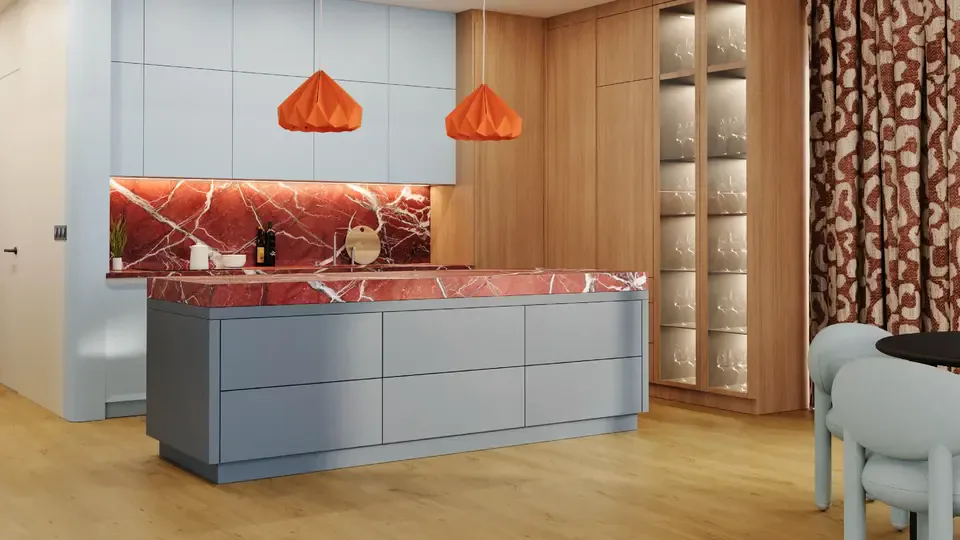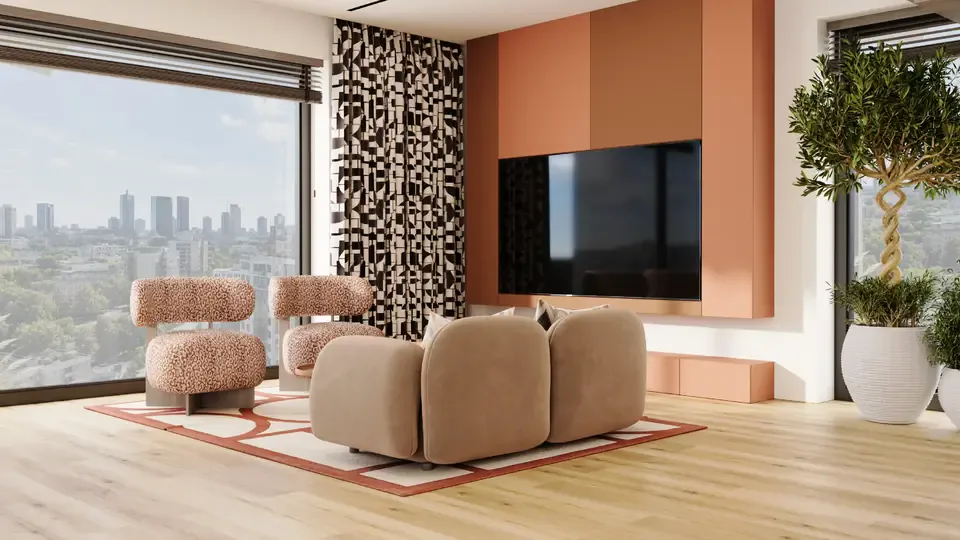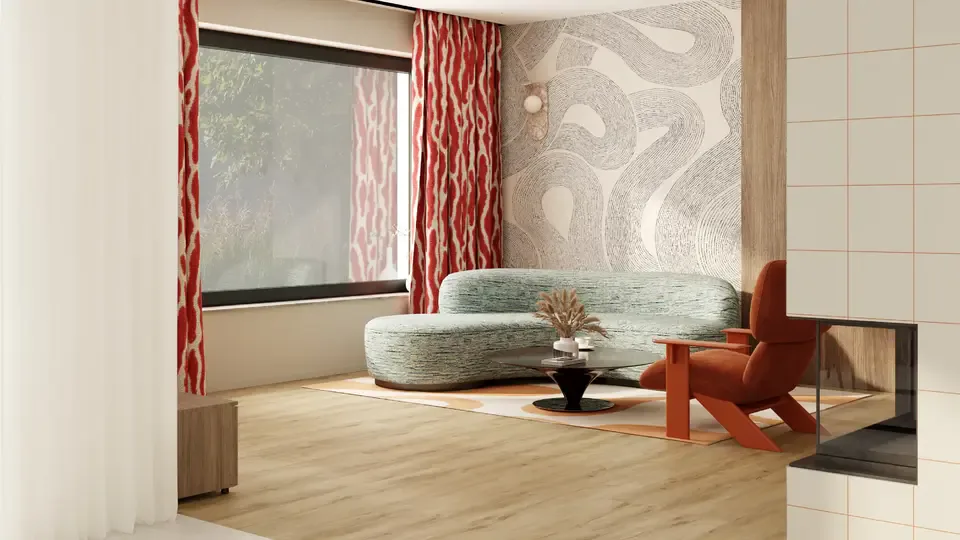
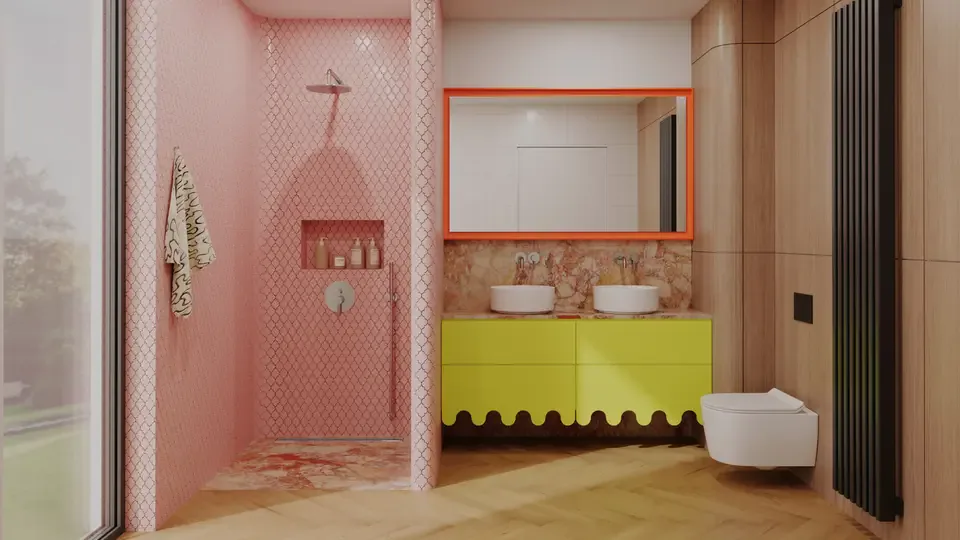
The kitchen and bathroom place extremely high demands on the floor. Water, steam, cleaning agents, spilled liquids and intensive use have made ceramic tiles the most frequently chosen solution in these rooms for years. An increasingly popular alternative is vinyl flooring for bathrooms and kitchens with a hard SPC core, which combines water resistance with the appearance of natural wood and comfort of use.
Why are the kitchen and bathroom demanding rooms?
In the bathroom, the floor is exposed to direct contact with water, high air humidity and frequent washing. In the kitchen, there are also stains from fat, sauces or wine, dropped dishes and intense traffic in the work area. The flooring material must therefore meet several conditions at the same time:
- be resistant to water and moisture
- maintain stable dimensions despite changes in temperature and humidity
- reduce the risk of slipping
- be stain-resistant and easy to clean
- maintain aesthetics despite intensive use
SPC core - the basis of water resistance
VinCore vinyl floors have a hard SPC core, which is a composite made of stone and polymers. Unlike wood-based materials, the SPC core does not absorb water and does not swell. Thanks to this, VinCore floors are fully waterproof and can be used in rooms exposed to moisture, such as the kitchen and bathroom.
Dimensional stability
In humid areas, not only water resistance is important, but also dimensional stability, i.e. how much the material changes dimensions under the influence of environmental conditions. In the test according to EN 23999, VinCore floors achieve a result of ≤ 0.15%, while the standard requirement is ≤ 0.25%.
Safety - anti-slip
A wet floor in the bathroom or kitchen increases the risk of slipping. VinCore floors have anti-slip class R10 according to DIN 51130 and class DS according to EN 13893. The matte polyurethane coating additionally reduces the effect of a slippery, shiny surface.
Stain resistant and easy to clean
In the kitchen, the floor comes into contact with substances every day that can leave permanent marks. In the stain resistance test according to EN 438, VinCore floors obtained class 5 for substance groups 1 and 2 and class 4 for group 3. Class 5 means no visible changes on the surface after contact with the test substance.
The smooth surface of the panels also makes daily cleaning easier. In most cases, vacuuming and washing with a slightly damp mop using an agent recommended by the manufacturer is sufficient.
Comfort that tiles cannot provide
Warmer surface to the touch
Vinyl flooring is warmer to the touch than ceramic tiles, which is especially important in the bathroom. VinCore floors are additionally approved for installation on water and electric underfloor heating, with a floor surface temperature not higher than 27°C and a gradual increase in temperature.
Quieter in open space
The integrated IXPE foam backing reduces impact sounds by 19 dB. In a kitchen open to the living room, this has a tangible impact on the acoustic comfort of the entire living area.
One floor in the kitchen, bathroom and living area
The waterproofness of the SPC core allows you to arrange the same decor in the kitchen, living room and bathroom. This continuity of the floor organizes the interior, visually enlarges it and eliminates the need to combine different materials at the border of the rooms. The solution works especially well in open layouts where the kitchenette is part of the living room.
When choosing a decor for rooms with heavy traffic, it is worth paying attention to the wearing layer. The WOOD+ and HERRINGBONE+ collections have a wear layer of 0.55 mm and a utility class of 23/33, and the WOOD and HERRINGBONE collections have a wear layer of 0.30 mm and a class of 23/31.
Which decors should you choose for the kitchen and bathroom?
The choice of decor depends primarily on the nature of the interior. Light shades such as TORINO or AMALFI optically enlarge small bathrooms and combine well with white sanitary ceramics. Warm, natural oaks, such as BARI or PERUGIA, add a homely character to the kitchen and go well with wooden fronts. The darker NAPOLI is a clear contrast to the light kitchen furniture. For a more decorative bathroom, a herringbone from the HERRINGBONE or HERRINGBONE+. collection will work well.
What should you pay attention to when choosing a floor for the kitchen and bathroom?
- Type of core - SPC core does not absorb water, unlike materials based on wood-based boards
- Anti-slip - in wet areas it is worth checking the class according to DIN 51130, VinCore floors have class R10
- Wearing layer - in a kitchen open to the living room, where there is the greatest traffic, a 0.55 mm layer works better
- Stain resistance - important especially in the kitchen work area
- Compatibility with underfloor heating - VinCore floors can be installed on water and electric heating if the floor surface temperature does not exceed 27°C
- The shade of the decor - it is best to evaluate it on a sample, in the light prevailing in a given room
Installation in the kitchen and bathroom - recommendations from the VinCore manual
VinCore panels are laid using the floating method, in the click system, without the use of glue, and the IXPE foam backing is integrated with the panel. In the kitchen and bathroom, the installation instructions contain several additional recommendations that determine the durability of the floor in wet areas. The most important of them are summarized in the table.
VINCORE · KITCHEN AND BATHROOM
Installation of vinyl flooring in the kitchen and bathroom
| Element | Recommendation according to VinCore instructions |
|---|---|
| Gaps in the bathtub and shower | Fill with MS or PU polymer sealant |
| Finishing profiles in wet rooms | Use MS or PU sealing compound under the profile |
| Kitchen furniture and island | Expansion joints around permanent elements |
| Heavy construction | Cut holes in the floor and mount the furniture directly on the floor |
| Floor load | Do not place objects over 300 kg directly on the floor |
| Moisture from the ground | Dry substrate; at the risk of moisture, vapor barrier foil |
| Spilled liquids | Wash off immediately |
Source: VinCore catalog and assembly manual.
Sealing in the bathtub, shower and under the skirting boards
Gaps in the bathtub, shower and other wet areas are filled with MS or PU polymer sealing compound. In humid rooms, i.e. bathrooms and kitchens, this mass is also used under the finishing profile. This seal prevents water from penetrating under the floor surface.
Expansion joints around kitchen furniture and islands
A floating floor needs freedom to work. The instructions require a 6 mm gap around the perimeter of the room and expansion joints around permanent elements, such as kitchen furniture, kitchen islands, sliding wardrobes, pipes or columns.
Heavy kitchen furniture
Do not place or install objects weighing more than 300 kg (with equal load) on a vinyl floor. In the case of heavy furniture or kitchen structures, the manufacturer recommends cutting holes in the floor and installing the furniture directly on the ground, maintaining expansion joints. It is worth taking this principle into account at the kitchen design stage.
Dry substrate and vapor barrier foil
Although the panels are waterproof, they do not function as a moisture barrier. Moisture from the subfloor will not damage the floor, but it can penetrate the walls and structure of the building. Therefore, before installation, the substrate must be completely dry: the humidity of the cement substrate should be below 2.5% and of the anhydrite substrate below 0.5%. If there is a risk of moisture and installation directly on the substrate, the instructions recommend a vapor barrier foil.
Installation on existing tiles
When renovating a bathroom or kitchen, VinCore panels can be laid on even ceramic tiles, provided that the joints are less than 2 mm deep and less than 4 mm wide. The existing cladding must be flat, dry, clean, stable and permanently bonded to the substrate. The manufacturer recommends smoothing the tiles with a cement leveling mortar. The substrate should be within a tolerance of 2 mm per 1 m and 1 mm per 20 cm.
Planning a kitchen or bathroom renovation with vinyl flooring
When renovating a kitchen or bathroom, it is worth planning the floor together with the buildings and installations. The VinCore instructions give several practical conclusions regarding the sequence of work:
- First, level the substrate, preferably with a self-leveling compound, and dry to the required humidity
- Building design - the places of heavy cabinets and kitchen islands must be marked before installation in order to cut out holes in the floor and maintain expansion joints around them
- Acclimatization of panels - at least 24 hours in the installation room, at a temperature of 18-27°C and air humidity of 30-50%
- Floor installation - maintaining a 6 mm gap near walls and permanent elements
- Sealing and finishing - MS or PU sealing compound in the bathtub, shower and under finishing profiles
The final assessment of the suitability of the substrate, e.g. its humidity, rests with the installer. The manual recommends using certified installers and, if in doubt, contact the manufacturer.
Kitchen open to the living room - expansion joints in thresholds and large spaces
One floor in the kitchen and living room is an aesthetic solution, but for larger surfaces it requires planning expansion joints. Areas larger than 200 m² and rooms longer or wider than 20 m should be divided with 8 mm wide expansion joints. The instructions also recommend expansion joints in door thresholds when there is a temperature difference between rooms, underfloor heating only works in one of them, the rooms differ significantly in shape or there are heavy elements in one of them.
Floor protection in the kitchen and dining room
In the kitchen and dining room, the floor is exposed to chairs moving and objects falling. The VinCore manual recommends felt pads under furniture legs, doormats at the entrance, and avoiding dragging heavy objects across the floor. The chair resistance is confirmed by the test results: VinCore floors have passed 25,000 cycles in the W-type wheel resistance test according to EN 425 without noticeable changes, and the residual dent according to EN 434 does not exceed 0.2 mm. Warranty cards, however, exclude damage caused by sharp objects, such as knives, so it is worth being careful in the kitchen work area.
Waterproofness and warranty
The VinCore warranty covers common water and food spills, provided they are cleaned up immediately. However, damage caused by flooding, plumbing failures or animal urine is not covered. Damage resulting from installation or care that is inconsistent with the manufacturer's technical documentation is also excluded, so it is particularly important to follow the instructions in the manual in the kitchen and bathroom.
Floor care in the kitchen and bathroom
Spilled liquids should be washed immediately and the floor should be cleaned with a damp, well-wrung out mop. VinCore instructions prohibit cleaning with steam or pressure washers. For daily cleaning, the manufacturer recommends dedicated agents that remove dirt and grease residues, which is particularly important in the kitchen. It is also worth checking the condition of seals in the bathtub and shower from time to time.
Frequently asked questions
Can vinyl flooring be installed in a bathroom with a shower?
Yes. VinCore floors are fully waterproof and intended for rooms exposed to moisture. Gaps in the shower, bathtub and under finishing profiles should be filled with MS or PU polymer sealing compound.
Can kitchen cabinets be placed on vinyl planks?
Heavy kitchen furniture should not be placed on a floating floor. The manufacturer recommends cutting holes in the floor and installing the furniture directly on the surface, maintaining expansion joints. Objects weighing more than 300 kg should not be placed on the floor.
Can vinyl planks be laid over bathroom tiles?
Yes, if the tiles are even, stable and have joints shallower than 2 mm and narrower than 4 mm. The manufacturer recommends smoothing the tiles first with a leveling mortar.
Is vinyl kitchen flooring stain resistant?
Yes. In the test according to EN 438, VinCore floors obtained class 5 for substance groups 1 and 2 and class 4 for group 3.
Is additional underlayment needed in the bathroom?
NO. VinCore panels have an integrated IXPE foam backing.
Summary
Vinyl flooring with an SPC core is a practical alternative to tiles in the kitchen and bathroom. Key conclusions:
- waterproof SPC core, dimensional stability, R10 anti-slip properties and stain resistance meet the requirements of humid areas
- gaps near the bathtub, shower and under finishing profiles are filled with MS or PU sealing compound
- heavy kitchen furniture is installed directly on the surface, in holes cut in the floor, maintaining expansion joints
- the substrate must be dry, and if there is a risk of moisture, a vapor barrier foil is used
- one decor can run through the kitchen, bathroom and living room, creating a coherent interior without division into materials
Looking for the perfect floor?
Discover our full range of vinyl flooring and find the ideal solution for your interior.
Want to see our articles more often in Google?
Add VinCore as a preferred source in Google Search so our guides and inspiration appear more often for you.
Add in Google