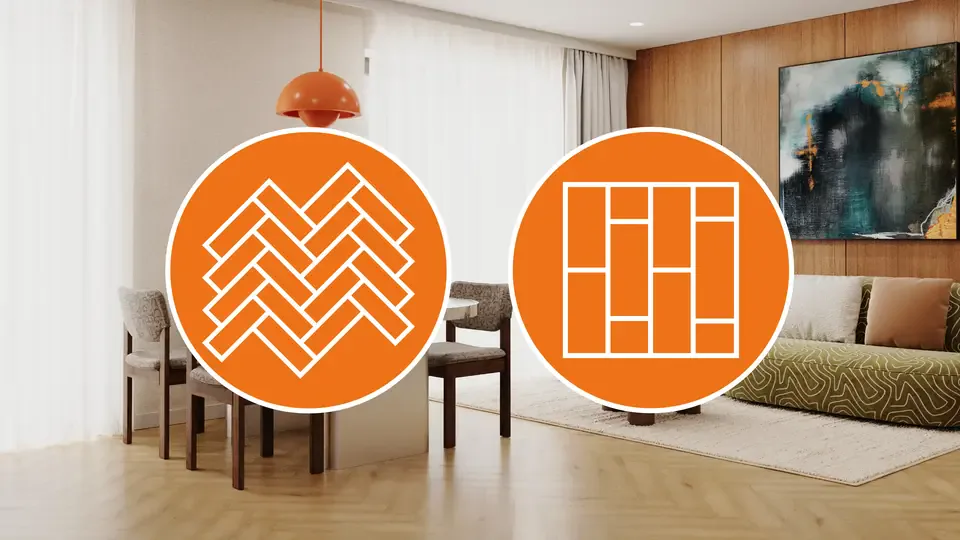
Choosing a floor is not only about the color and type of material, but also about its layout. It is the format and way of arranging the panels that largely determine the character of the interior and its proportions. Herringbone or board - both solutions have their advantages, and the choice between them depends on the size of the room, the style of arrangement and the effect the floor is to create.
Board - universal floor format
The board is the most classic and most frequently chosen floor format. The panels are placed in parallel, usually along the longer wall or in the direction of the light. This arrangement creates a calm, uniform surface that does not dominate the arrangement, and at the same time clearly highlights the grain and structure of the wood.
VinCore's offer includes board formats of 180 × 1220 mm with a regular wood structure: WOOD and WOOD+. Boards with such proportions visually lengthen the room and work well in almost any style, from minimalism, through Scandinavian style, to classic and industrial arrangements.
Advantages of the board
- universal character that suits most styles
- calm, uniform visual effect
- optical extension of the room
- simpler installation than in the case of herringbone, which is assessed by the manufacturer as moderately difficult to install
Herringbone - a classic with a decorative character
Herringbone is a layout in which shorter tiles are connected at right angles, creating a characteristic, repeatable pattern. For years, it was associated mainly with parquet floors in tenement houses and representative interiors. Today, it is also coming back into favor in modern arrangements, where it is a distinctive decorative element.
VinCore's offer includes a classic herringbone pattern in the 125 × 625 mm format with a delicate wood structure in the HERRINGBONE and HERRINGBONE+. collections. The decors are inspired by French regions and cities, and their character fits well into both classic and contemporary interiors.
Advantages of herringbone
- expressive, elegant character of the floor
- dynamics and rhythm in the interior
- possibility of giving the floor the role of the main element of the arrangement
- a timeless design that does not lose its relevance
How does the floor arrangement affect the interior proportions?
A board laid lengthwise will visually lengthen the room, and a board laid across it can widen a narrow interior. Long connecting lines organize the space and make it seem calmer.
Herringbone works differently. Its pattern leads the eye deeper into the room and gives it dynamics. In large interiors, it emphasizes their representative character, and in smaller ones it can become a distinctive accent, provided that a light decor is chosen and the rest of the arrangement remains subdued.
Herringbone or board - in which rooms?
Living room and dining room
Both layouts work well in the living room. The board creates a neutral background for furniture and accessories, while the herringbone gives the interior elegance and constitutes its distinct element. In an open living area, it is worth choosing one layout for the entire space to maintain consistency.
Bedroom
In the bedroom, a board is more often chosen, as it favors a calm, tranquil character of the interior. Herringbone will work well where the bedroom has a more classic or hotel character.
Hall and corridor
In the hall, the herringbone creates an impressive first impression. Since this is a high-traffic area, it is worth considering a collection with a 0.55 mm wear layer, i.e. HERRINGBONE+ or WOOD+, with a usability class of 23/33.
Kitchen and bathroom
All VinCore floors have a waterproof SPC core, so both plank and herringbone can be used in the kitchen and bathroom. The choice of layout depends solely on the nature of the arrangement.
Board and herringbone in numbers - comparison
Both formats have the same construction: hard SPC core, integrated IXPE foam backing and click floating assembly. They differ in dimensions, lock system, surface structure and installation method.
VINCORE · BOARD OR HERRINGBONE
Comparison of VinCore board and herringbone formats
| Characteristic | Board (WOOD, WOOD+) | Herringbone (HERRINGBONE, HERRINGBONE+) |
|---|---|---|
| Format | 180 × 1220 mm | 125 × 625 mm |
| Click system | Uniclic | Unidrop X |
| Surface structure | Regular wood structure | Delicate wood structure |
| Package | 10 pcs / 2.2 m² | 12 pcs / 0.94 m² or 16 pcs / 1.25 m² |
| Types of boards | One kind | Boards A and B in equal numbers |
| Starting point for assembly | Left corner of the room, next rows | Mainline and starter kits |
| Connection | Edges joined at an angle | Long ones at an angle, short ones tapped with a rubber hammer |
Source: VinCore catalog.
Differences in the installation of boards and herringbones
When choosing a system, it is also worth taking into account the assembly process. Each format has a separate instruction: WOOD and WOOD+ boards are combined in the Uniclic system, and HERRINGBONE and HERRINGBONE+ boards are combined in the Unidrop X system. Some rules are common, for example acclimatization of the panels for at least 24 hours, a 6 mm gap around the perimeter of the room and expansion joints around fixed elements.
Board installation
The installation of the boards begins with the first, entire panel in the left corner of the room, placed tongue-wise against the wall. Subsequent boards are connected at an angle and lowered to the ground. The second row starts with a cut piece of the last panel from the previous row, provided it is at least 30 cm long. End joints in adjacent rows should be at least 30 cm apart. Thanks to this, the floor is stable and the arrangement of the boards looks natural.
Herringbone installation
The manufacturer describes the herringbone assembly as moderately difficult and emphasizes that the boards must be connected very carefully and precisely. Each HERRINGBONE and HERRINGBONE+ package contains the same number of A boards and B boards. They are arranged alternately, creating a characteristic pattern. The long edges are joined at an angle and the short edges are tapped with a rubber hammer. According to the instructions, incorrectly connecting the panels may result in rejection of the complaint.
Before starting the installation, choose a herringbone pattern and plan the floor in the room. The instructions list the two most popular patterns, classic and basket, and describe in detail the assembly of the classic pattern:
- Main line - it is marked through the center of the room, it is a reference point for the entire pattern
- Starter sets - each consists of 3 A boards and 3 B boards, which after cutting form a triangle. The number of sets depends on the width of the room
- First row - sets are connected, starting from the left with board A
- Second row - starts from the right side with board B, subsequent rows are arranged alternately
- Finishing at the walls - the boards are cut at the ends of the room, maintaining a 6 mm gap
Due to the precision required for herringbone construction, it is worth entrusting the installation to an experienced installer. The manual recommends using certified installers and, if in doubt, contact the manufacturer.
Material demand
The formats also differ in packaging content. A package of WOOD and WOOD+ boards contains 10 pieces, i.e. 2.2 m². The HERRINGBONE package contains 12 pieces (0.94 m²), and the HERRINGBONE+ package contains 16 pieces (1.25 m²). The herringbone layout usually involves more cuts near the walls, which is worth taking into account when calculating the amount of material.
How to match the decor to the layout?
Decors with more visible grain and knots, such as SICILY or MILANO from the WOOD collection, work well in the board format, because the long panels fully expose the wood structure. Bright, calm decors, for example TORINO or BARI from the WOOD+ collection, work well in minimalist interiors.
In herringbone, the pattern creates the arrangement itself, so decors with a delicate, uniform grain work best. Light shades such as STRASBOURG or NORMANDY from the HERRINGBONE collection emphasize the herringbone pattern without overwhelming the interior. Warmer tones, such as CORSICA or LYON from the HERRINGBONE+ collection, give the interior a more classic character.
Board or herringbone and interior style
It is also worth choosing the floor layout to match the arrangement style, because each of them emphasizes different features of the interior.
- Scandinavian style and minimalism - most often a board in a light, natural shade that creates a calm background. Light herringbone will work well where the floor is to be a delicate decorative accent
- Industrial style - usually a board that shows off its distinctive grain and knots. Herringbone can be a classic contrast to brick and metal
- Classic and modern classic style - herringbone, which refers to traditional parquet floors and emphasizes the representative character of the interior
- Modern interiors - both layouts, the choice depends on whether the floor is to be a neutral background or an expressive element of the arrangement
Can you combine board and herringbone in one apartment?
Yes, although it requires some thought. A common solution is herringbone in the living room or hall and board in the bedrooms. When combining formats, it is worth remembering two things. Firstly, the collections differ in thickness: WOOD and HERRINGBONE are 5 mm, and WOOD+ and HERRINGBONE+ are 6 mm. The easiest way is to keep one floor level by choosing a board and herringbone from the same version, i.e. WOOD from HERRINGBONE or WOOD+ from HERRINGBONE+. Secondly, the instructions recommend expansion joints in door sills between rooms that differ significantly in shape or dimensions, for example between a narrow corridor and a large living room.
It is worth choosing the decor so that both formats create a coherent whole. The safest option is a combination of similar shades or a conscious contrast, for example a light herringbone in the living area and a warmer board in the bedroom.
Board and herringbone on underfloor heating
Both formats can be installed on water and electric underfloor heating according to the same principles. The WOOD and HERRINGBONE installation instructions specify the maximum floor surface temperature at 27°C, require a gradual increase in temperature and the use of thermal seals, and, in the case of electric heating, also an element controlling the temperature increase. The installation must be embedded in the ground at least 15 mm below the floor.
The most common mistakes when choosing a floor layout
- Choosing a herringbone pattern without a plan - the pattern requires marking a main line; a poorly planned axis may make the pattern asymmetrical in relation to doors or windows
- Self-assembly of the herringbone without experience - the manufacturer assesses it as moderately difficult, and improper connection of the panels may result in the rejection of the complaint
- Combining collections of different thickness without planning a passage between rooms
- Underestimating the material - when using herringbone, you need to take into account a larger number of cuts near the walls
- Choosing a decor based only on the photo - the same decor may look different in a board and herringbone arrangement, so it is worth seeing it live in the showroom
When to choose a board and when to choose a herringbone board?
The board will work well when:
- the floor is intended to be a neutral background for the arrangement
- the interior is kept in a minimalist, Scandinavian or industrial style
- the room needs optical extension
- simpler installation is important
Herringbone will work well when:
- the floor is to be the main decorative element of the interior
- the arrangement has a classic, elegant or modern classic character
- the interior has a representative character, for example a hall or a living room
- the goal is to give the space dynamics and rhythm
Frequently asked questions
Does herringbone fit a small room?
Yes, if the decor is bright and the remaining elements of the arrangement are subdued. A herringbone pattern leads the eye deeper into a room and can add character without overwhelming it.
Do herringbone and VinCore board have the same parameters?
Collections in the same version have the same performance parameters. WOOD and HERRINGBONE have a thickness of 5 mm and a wear layer of 0.30 mm, and WOOD+ and HERRINGBONE+ have a thickness of 6 mm and a wear layer of 0.55 mm. They differ in format and surface structure.
Can you arrange the herringbone tree yourself?
It is possible, but the manufacturer assesses the installation of the herringbone as moderately difficult and requires precise connection of the A and B boards. Improper connection of the panels may result in rejection of the complaint, so it is worth entrusting the installation to an experienced installer.
What herringbone patterns can be made with VinCore panels?
The assembly instructions for HERRINGBONE and HERRINGBONE+ list the two most popular patterns: classic and basket. It describes in detail the assembly of the classic pattern.
Can herringbone be laid in the kitchen or bathroom?
Yes. The HERRINGBONE and HERRINGBONE+ collections have a waterproof SPC core, just like the boards.
Summary
The choice between herringbone and board is primarily a decision about the character of the interior. The board from the WOOD and WOOD+ collections provides a universal, calm effect and fits most arrangements. Herringbone from the HERRINGBONE and HERRINGBONE+ collections adds elegance to the space and becomes its distinct element. Both systems combine the same properties: waterproof SPC core, integrated backing and click assembly. However, they differ in the assembly process: the board is laid more simply, while the herringbone requires marking the main line, connecting boards A and B and high precision, so it is worth entrusting it to an experienced installer.
Looking for the perfect floor?
Discover our full range of vinyl flooring and find the ideal solution for your interior.
Want to see our articles more often in Google?
Add VinCore as a preferred source in Google Search so our guides and inspiration appear more often for you.
Add in Google